Chain link mesh looks like a commodity. It is not. Two rolls that appear identical on a shop floor can differ by several wire gauges and by the thickness of their galvanising, and the difference only becomes visible after the second monsoon — by which point the cheaper roll is rusting and the fence needs replacing. We weave our own mesh in Mysore, so here is what actually matters when you buy it.
Wire gauge — the one that decides lifespan
Gauge is the wire thickness, and it runs backwards: a lower number is a thicker wire. 8G is heavy; 14G is light. Gauge determines how much force the fence takes before it deforms and how long it survives corrosion, because a thicker wire has more metal to lose before it fails.
| Gauge | Character | Suits |
|---|---|---|
| 8G – 10G | Heavy | Security boundaries, industrial compounds, cattle and large livestock |
| 10G – 12G | The workhorse range | Farm and plot boundaries, factory compounds, general fencing |
| 12G – 14G | Light | Poultry runs, garden and landscaping enclosures, partitions |
Gauge to millimetres
Indian mesh is specified in SWG (Standard Wire Gauge). These are the standard wire diameters — measure a delivered roll with a vernier and compare. Measure the bare wire on galvanised mesh; on PVC-coated mesh the gauge refers to the core wire, not the outside of the coating.
| Gauge (SWG) | Wire diameter | Steel compared with 12G |
|---|---|---|
| 8G | 4.06 mm | about 2.4× |
| 10G | 3.25 mm | about 1.5× |
| 12G | 2.64 mm | — |
| 14G | 2.03 mm | about 0.6× |
If you are being quoted an unusually low price, gauge is where the saving almost always is. Ask for the gauge in writing and check the delivered roll against it.
Mesh size — what you are keeping out
Mesh size is the diamond opening, typically 1" to 3" (25 mm to 75 mm; 1.5" is 38 mm, 2" is 50 mm, 2.5" is 63 mm). Bigger diamonds use less wire and cost less; smaller diamonds are harder to climb, harder to cut through and stop smaller animals.
- 2" – 3" — standard farm and compound boundary. Economical, adequate for demarcation and for keeping out cattle and people.
- 1.5" — a good middle choice where the boundary faces a road or a public area.
- 1" – 1.25" — security-critical boundaries and animal enclosures. Fingers do not fit, which makes it far harder to climb.
Coating — galvanised or PVC
Hot-dip galvanised mesh is the default and the right answer for most inland farm and industrial boundaries. The zinc coating is what stands between the steel and the weather, and — like gauge — its thickness is somewhere a supplier can quietly economise.
PVC-coated mesh puts a polymer jacket over the galvanised core. It is worth the extra in three situations: high-rainfall Malnad conditions, coastal salt air, and any boundary that is on public view — villa compounds, schools, parks — where the softer finish simply looks better and is safer to handle.
The part people forget: posts
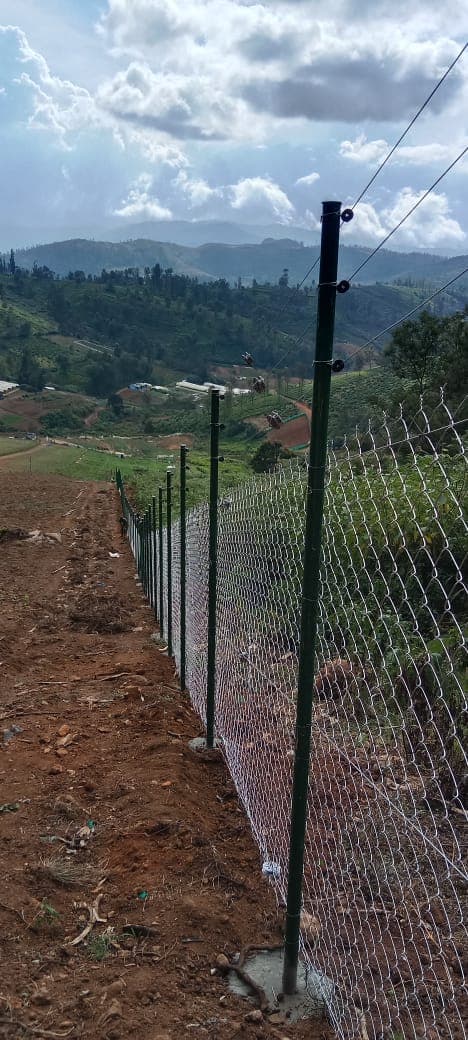
Good mesh on bad posts is a bad fence. GI angle posts are quick to install and fine for compounds. For farm boundaries we usually recommend dressed stone posts set in concrete: they cost more on day one, then never rot, rust or need painting. We have stone-post fences still standing on farms we built them for twenty years ago.
Post spacing matters as much as post type. Too far apart and the mesh sags between them within a year, which is the most common reason a chain link fence looks tired long before the wire has actually failed.
Combining mesh with a solar line
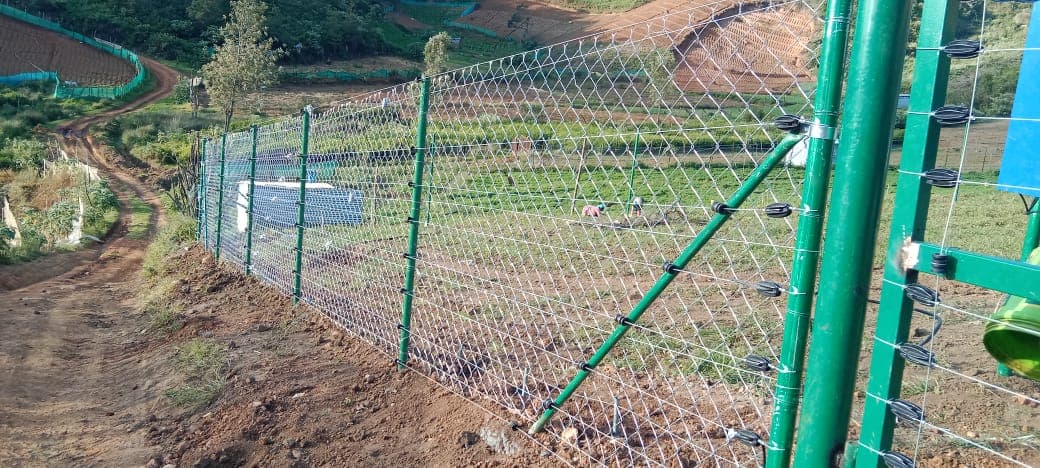
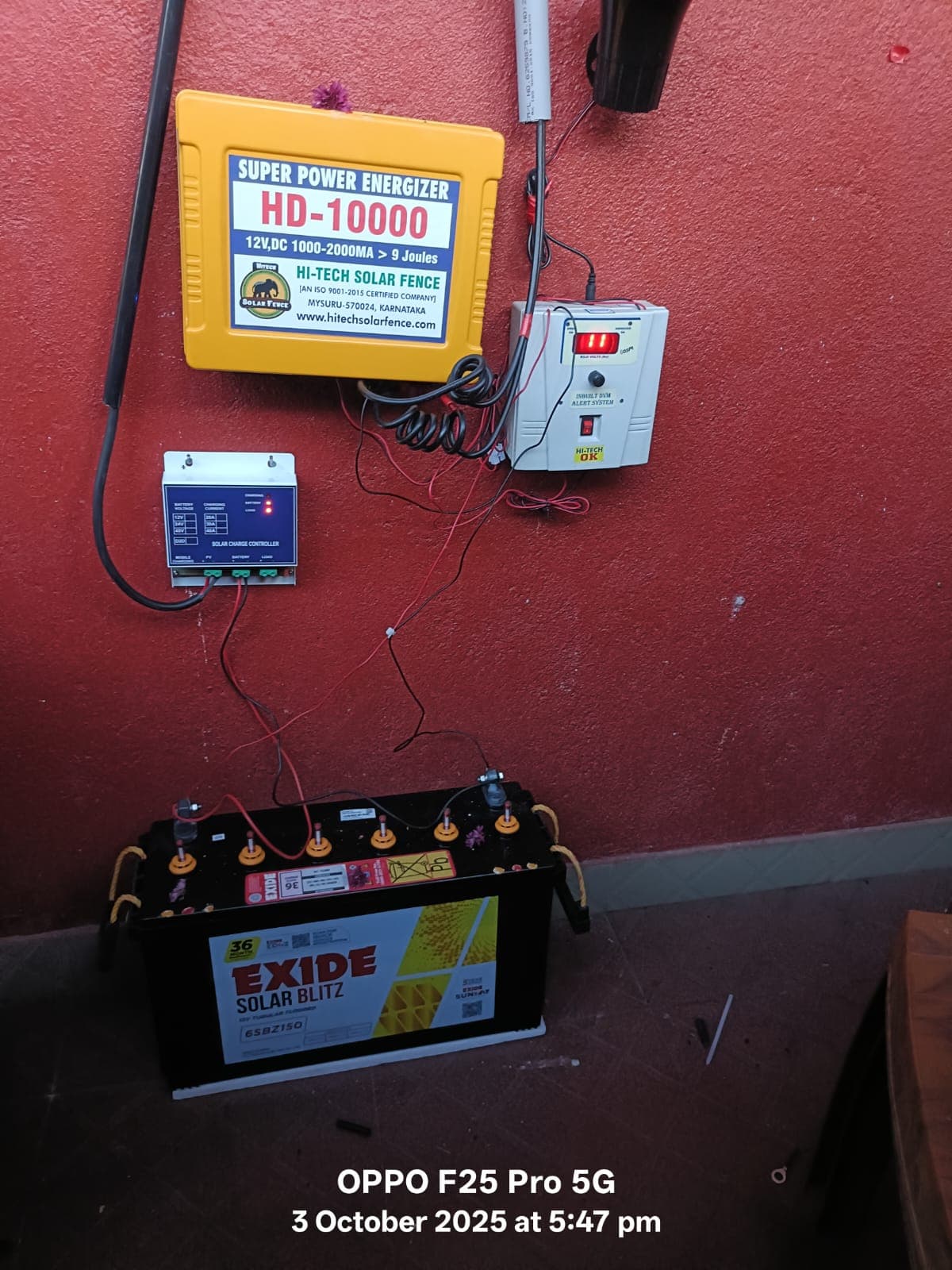
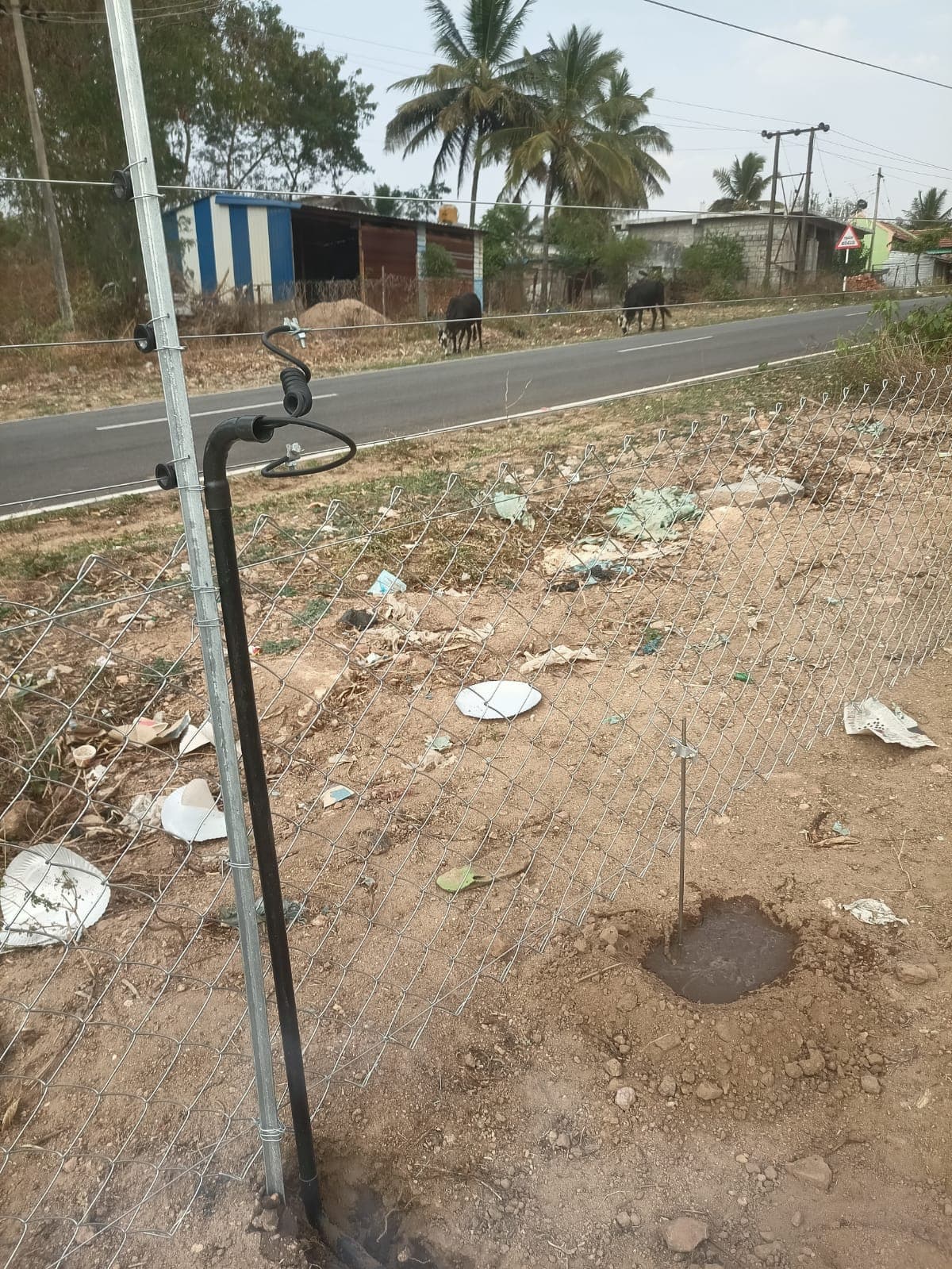
A chain link fence is a physical barrier — it stops what walks into it and it marks your boundary. It does not deter anything that is determined to climb or cut. Running a solar electric line along the top of the mesh turns a passive barrier into an active deterrent, and it is the combination we install most often on farm boundaries. It is also considerably cheaper to add at the time of building the fence than to retrofit later.
Common questions
- What gauge chain link is best for a farm boundary?
- 10G to 12G covers most farm boundaries — enough metal to survive years of weather and stock pressure without paying for security-grade wire. Go heavier if you are containing large livestock or fencing a boundary with a real theft risk.
- Is PVC-coated mesh worth the extra cost?
- In high-rainfall Malnad districts, in coastal air, and on boundaries that are seen from the road — yes. On a dry inland farm boundary, properly galvanised mesh does the job and the PVC is optional.
- What is the difference between 10 gauge and 12 gauge chain link?
- 10G wire is 3.25 mm thick and 12G is 2.64 mm. That sounds small, but it is about 50% more steel in every strand — noticeably stiffer, harder to cut, and with more metal to lose to corrosion before the fence fails.
- Can I buy mesh without installation?
- Yes. We sell by the roll, made to the mesh size, gauge and height you need, and we also do the complete installation with posts and gates if you would rather one supplier handled the whole job.