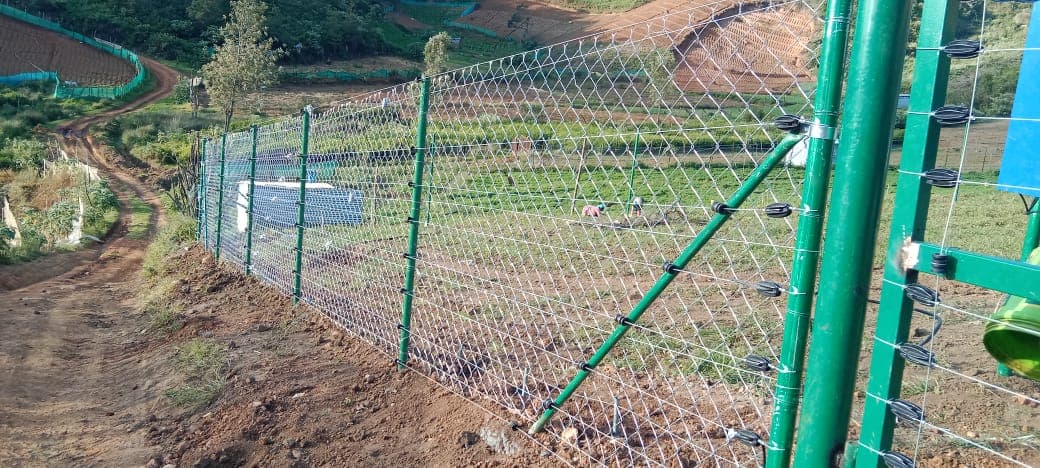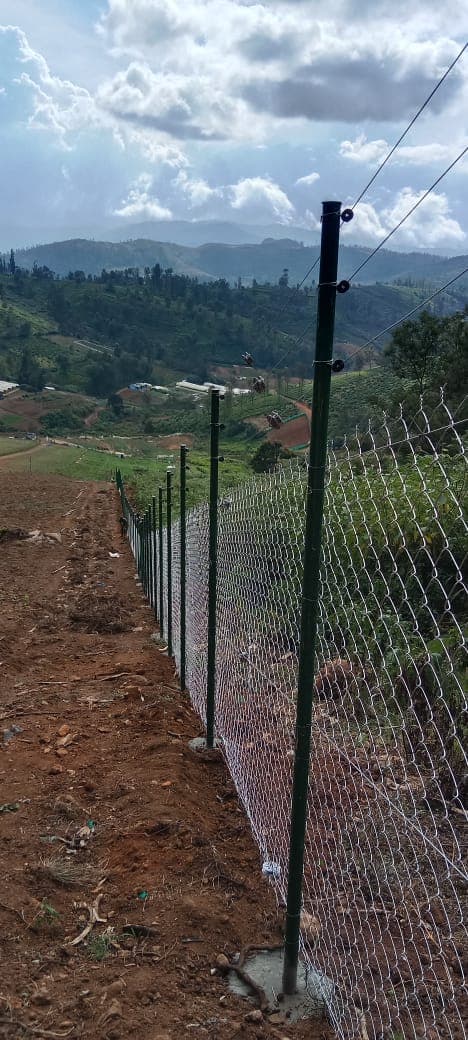
A fence that works perfectly on a Mandya field boundary can fail within a season on a Kodagu estate. The conditions are genuinely different — longer perimeters, steep and broken ground, four months of serious rain, and an animal that is patient and clever enough to test the fence for weaknesses rather than simply charging it. Here is what that changes about how the fence has to be built.
Elephants do not behave like other crop raiders
Boar push through at ground level. Deer jump. Elephants investigate. They will test a line with a foot or a tusk — parts of the body with far less sensitivity than the trunk — and they remember which stretch of a boundary was weak last season. Three consequences follow from that:
- The fence must be strong everywhere, not on average. One weak hundred metres is the whole fence, because that is the stretch they will come back to.
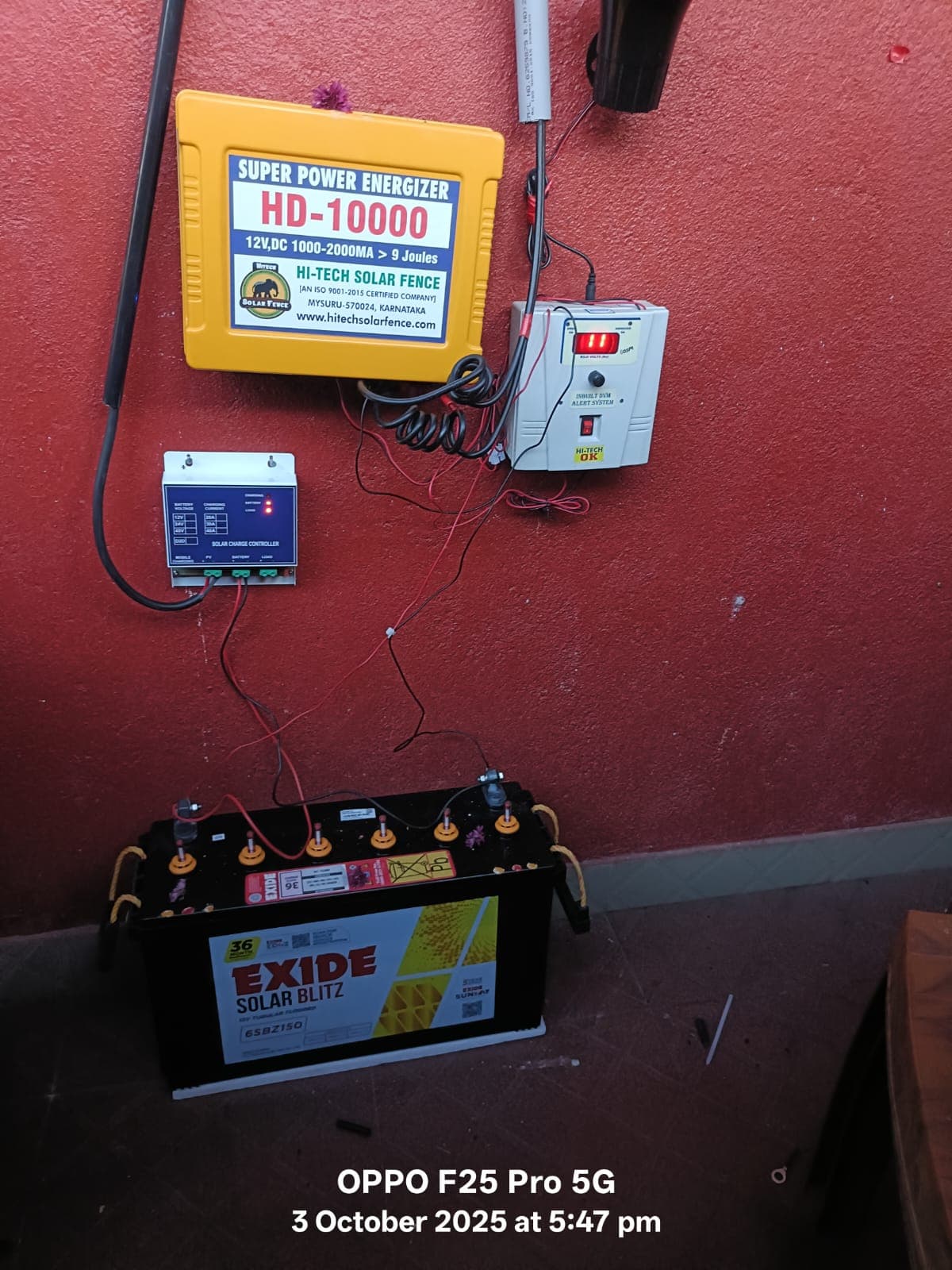
- It needs enough energy to be memorable through thick hide, which is why estate perimeters run HD-6000 and HD-8000 class energizers rather than farm-sized units.
- Line height and spacing must be designed for the trunk and shoulder, not scaled up from a boar fence.
The terrain problem
Estate boundaries do not run in straight lines across flat ground. They climb, drop into valleys, cross streams and turn constantly around blocks. Every one of those turns is a strain point that carries tension, and strain points are where fences fail. On slopes the line also has to follow the ground rather than cutting across it — a wire that lifts away from the contour leaves a gap underneath that an animal will find.
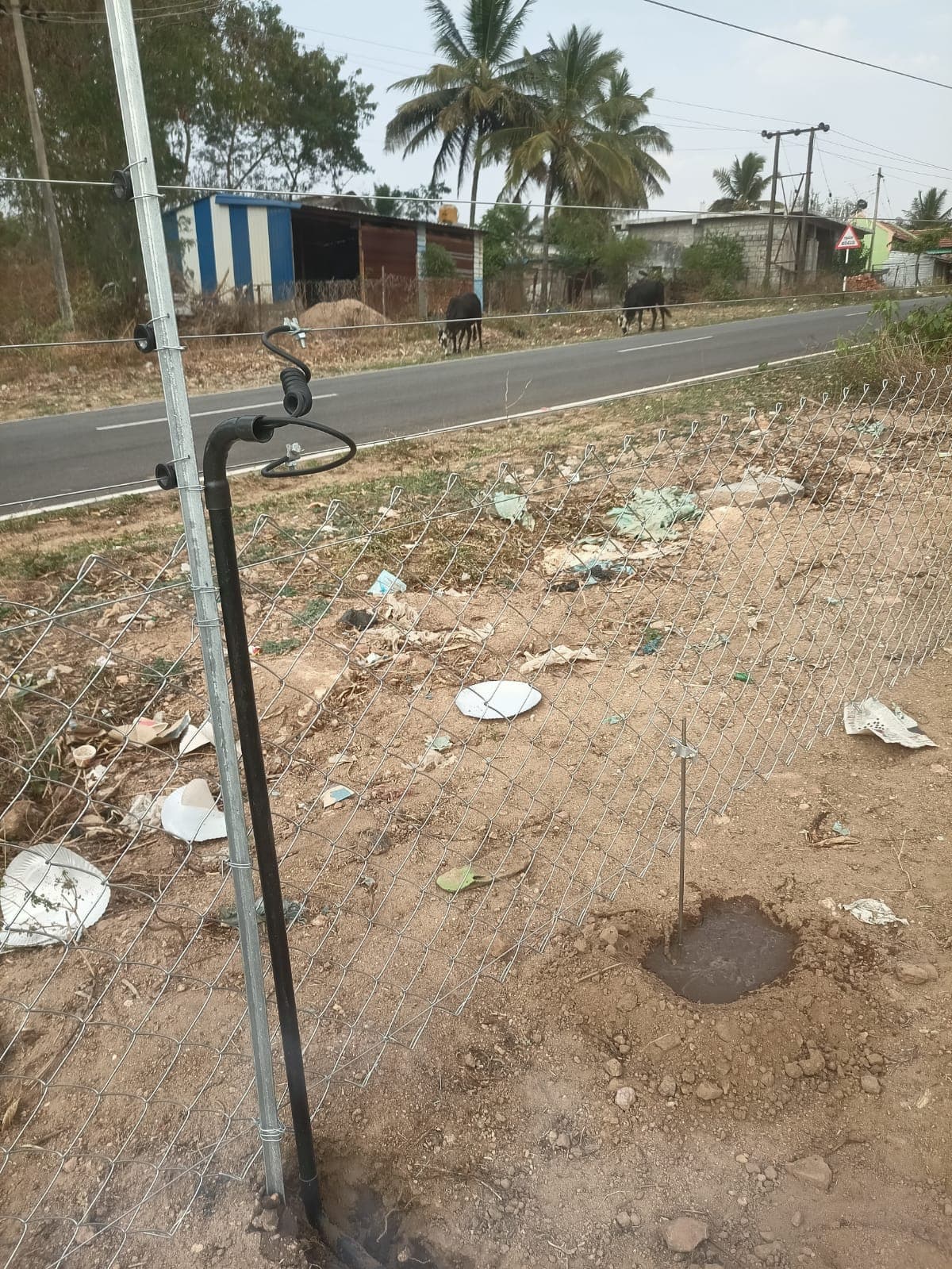
This is why corner and strain hardware matters more on an estate than anywhere else. We use polycarbonate polycarbonate insulators rated to 15 kV at every turn and end, and strain insulators inline wherever the wire is genuinely tensioned. On a hill run those components are doing constant work.
Monsoon is the real test
Malnad rain attacks a fence in three ways at once, and all three are about voltage leaking to ground:
- 1Growth. Everything grows explosively for four months. Vegetation leaning on a live wire is the single largest cause of estate fence failure, and the stretch that grows fastest is usually the stretch furthest from the bungalow.
- 2Damp. Constant moisture shortens the electrical path between a live wire and its post. This is why insulator profile matters — a deep-groove reel insulator keeps a long creepage distance that a flat clip does not.
- 3Falling branches. Wind and saturated soil bring limbs down across the line, often in blocks nobody walks for weeks.
The third one is the argument for monitoring. On a large estate you cannot walk the whole perimeter daily during the monsoon, which means a branch can take a line out on Monday and you learn about it from crop damage on Friday. A DVM alert system sounds a hooter on a voltage drop; a GSM unit texts you. On estate boundaries this is not a luxury item.
Deterrent, not weapon
Everything we install is non-lethal by design. The pulse startles and teaches; it does not injure. That matters legally, it matters to the forest department, and it matters practically — a fence that harms elephants creates a conflict that gets worse, while a fence that teaches them the boundary tends to work better each season as the herd learns the line.
A realistic maintenance rhythm
- Pre-monsoon: clear the full line, check every corner and strain insulator, test and record voltage, service the earth stakes.
- During monsoon: clear the fast-growing stretches on a schedule rather than on discovery; check readings weekly.
- Post-monsoon: walk the whole perimeter for branch damage and re-tension the runs that have gone slack.
Common questions
- Is an electric fence legal and safe for elephants?
- Yes, when it is a properly installed non-lethal system with correct warning signage. Our fences deliver a short pulsed shock that startles without injuring — that is the design intent throughout, and it is what makes the fence acceptable at forest boundaries.
- How long a perimeter can one energizer handle?
- It depends on total wire length rather than boundary length — a four-line fence is four times the wire. An HD-6000 comfortably handles long multi-wire estate perimeters, and the HD-10000 reaches around 2 km of multi-wire depending on layout and vegetation. We size it during the survey.
- Will the fence survive the monsoon?
- The hardware will if it is the right hardware — UV-stable insulators with proper creepage, galvanised fittings, and corner components built for permanently tensioned hill runs. What needs attention every year is vegetation and fallen branches, which is what a maintenance rhythm and a monitoring system are for.