Most farmers we talk to know a subsidy exists and are not sure how to get it. The scheme runs through the state horticulture and agriculture departments, and while the mechanics are not complicated, the sequence matters — do things in the wrong order and you can find yourself ineligible for work you have already paid for.
Which scheme this is — and is sprinkler covered?
The micro-irrigation subsidy comes under the Per Drop More Crop component of the Pradhan Mantri Krishi Sinchayee Yojana (PMKSY), funded jointly by the centre and the state. It covers both drip and sprinkler systems — so the sprinkler set and pipe subsidy farmers ask about is the same scheme, with the same sequence below.
In Karnataka it is run through two departments. Broadly, horticulture crops — arecanut, coconut, banana, vegetables, fruit — go through the Department of Horticulture at your taluk office, and field crops go through the Department of Agriculture via your Raitha Samparka Kendra (RSK). If you are unsure which applies to your crop, ask at either office; they will send you to the right one.
The sequence
- 1Approach the department before you buy anything. This is the step people get wrong. Approval generally precedes installation; material bought and installed first can fall outside the scheme.
- 2Registration. You need a FRUITS ID — Karnataka’s farmer registration, which links your land records and Aadhaar — and your land records in the right name. Mismatches between the RTC and the applicant are the most common reason an application stalls.
- 3Get a designed quotation. The department wants a system specification, not a lump sum — the components, the layout and the area to be covered.
- 4Departmental approval. Once sanctioned, you have a defined scope of work that the subsidy applies to.
- 5Installation by a registered supplier. The material has to be from an approved manufacturer and the supplier has to be registered under the scheme.
- 6Inspection and release. A department officer verifies the installed system against the sanctioned specification, and the subsidy is released to the beneficiary account.
What to have ready
- Land records (RTC / pahani) in the applicant’s name
- Aadhaar and bank account details for the beneficiary
- Your FRUITS farmer ID — the RSK can register you if you do not have one
- A source-of-water detail — borewell, open well or canal
- The designed quotation with the component specification
If the land is jointly held or recently inherited, sort the records out before you start rather than halfway through. That single issue delays more applications than anything else.
Applying online, and the "PDF form"
Many people search for a downloadable application PDF. There is no single form that works everywhere: the format is issued by the department, it changes between seasons, and an old copy downloaded from a third-party site can be rejected. Collect the current form from your taluk horticulture office or RSK — which is also where you find out whether online submission is open in your district this season and when the application window closes.
What we do and what we do not
We will design the system, give you the itemised quotation the department asks for with the actual Netafim components listed, tell you what currently applies to your category, and supply the documentation from our side. The application itself is made by you — the subsidy is paid to the beneficiary, and any supplier who offers to "handle the whole thing" for you should be asked exactly what that means.
Do not let the subsidy design the system
The most expensive mistake in drip irrigation is not paying too much. It is installing a system that has not been hydraulically designed — one that waters the first block properly and starves the last one. That happens when the layout is drawn to fit a sanctioned amount rather than to fit the field.
Two things decide whether a drip system still performs in year five:
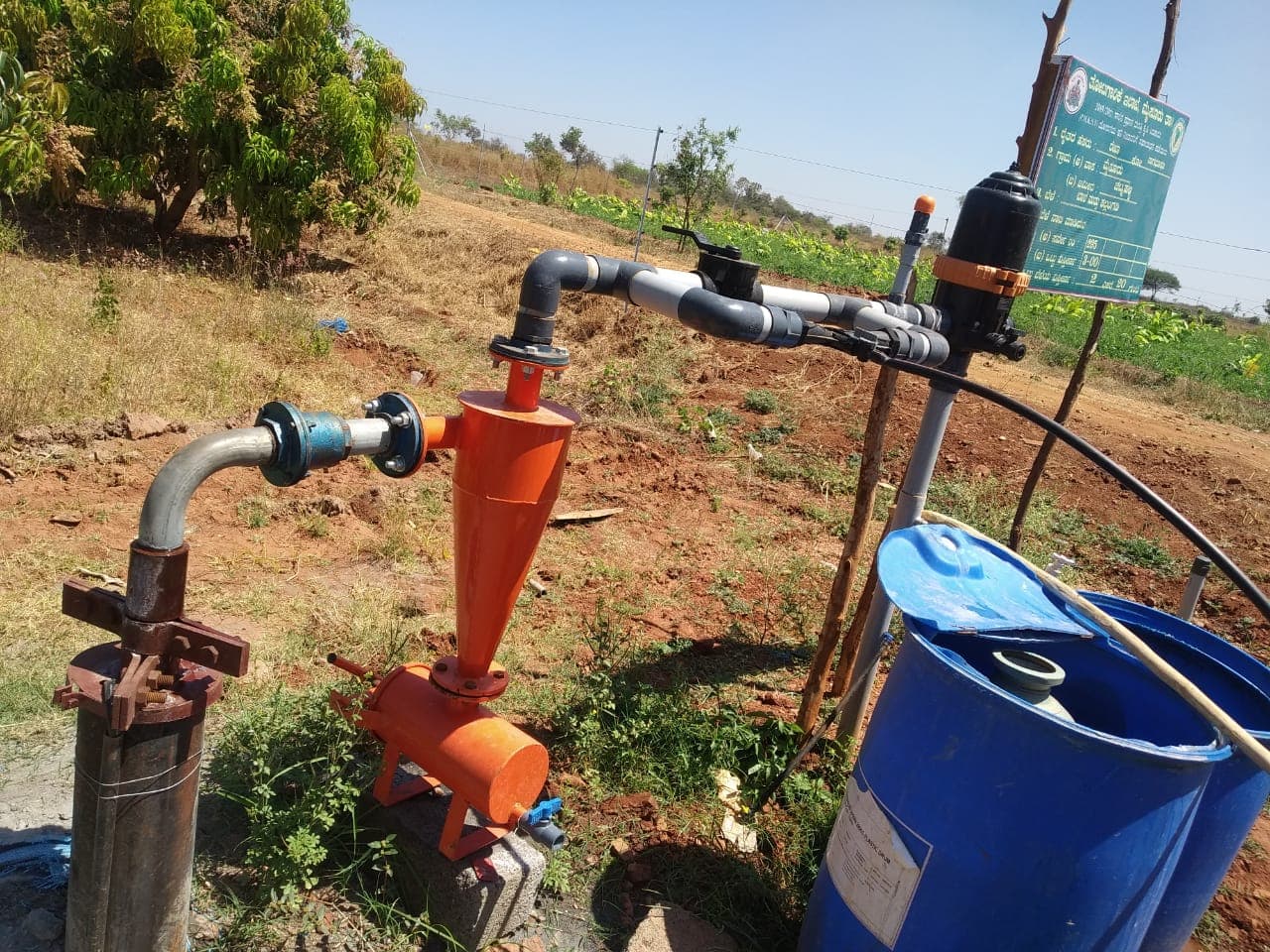
- Filtration sized to your actual water. Bore water carrying silt or iron will clog emitters if the filter is undersized, and no amount of subsidy makes a clogged system worth having. We do not quote a system without filtration matched to the water.
- Block and lateral sizing from real flow and pressure figures. Measured at your pump, not assumed.
Get those right and drip typically cuts water use by 30–50% against flood irrigation, because the water reaches the root zone instead of evaporating off the surface or running off — and the pump runs fewer hours, which saves power as well.
Common questions
- Can I claim the subsidy on a system I have already installed?
- Generally no — approval is expected before installation. This is the single most common reason a claim fails, so talk to the department before you commit to any work.
- Does the subsidy cover any brand of drip material?
- The scheme requires material from approved manufacturers, installed by a registered supplier. We are an authorised Netafim dealer and supply genuine Netafim material, quoted with the actual components listed.
- How long does the process take?
- It varies by district and by how clean your land records are. Records in order and a properly specified quotation are what move it along; a name mismatch on the RTC is what stalls it.
- Is the sprinkler and sprinkler-pipe subsidy the same scheme?
- Yes. Drip and sprinkler both come under PMKSY – Per Drop More Crop, and the process is the same: department approval first, a designed quotation, installation by a registered supplier, then inspection. Which office you apply through depends on the crop.
- Do I need a FRUITS ID to apply?
- Karnataka uses FRUITS, its farmer registration system, to link your land records and Aadhaar for government schemes and payments. Have it in place before you apply — your Raitha Samparka Kendra can register you.
- Can I apply for the drip irrigation subsidy online?
- It depends on the district and the season. Your taluk horticulture office or RSK will tell you whether online submission is open and give you the current form; avoid application PDFs from third-party sites, which are often out of date.